Tesla Powerwall 3 Will Soon Be Compatible With Existing Powerwall 2 Systems

Jake Best
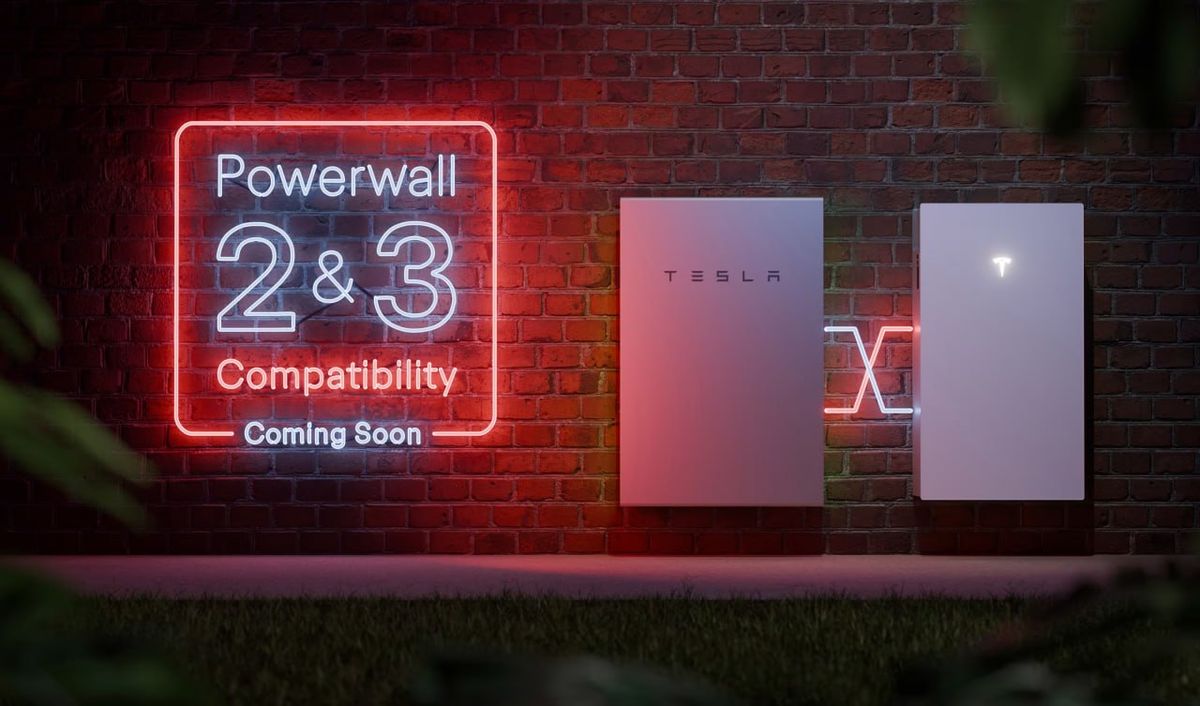
Tesla has announced an important update for existing Powerwall 2 owners: beginning with Powerwall software version 26.26, a new Powerwall 3 can be added to certain existing Powerwall 2 systems.
This upcoming compatibility update addresses one of the biggest concerns for homeowners who already own Powerwall 2 batteries. Until now, adding storage generally required locating another Powerwall 2 or replacing the existing system. Once the new software is released, many qualifying homeowners will be able to expand their battery capacity using Powerwall 3 while keeping their existing Powerwall 2 units.
Tesla currently estimates that Powerwall version 26.26 will become available around mid-August 2026. Compatibility will depend on the design, equipment and code requirements of the existing installation.
What Is Changing?
With Powerwall version 26.26 or later, one Powerwall 3 can be installed at an existing site containing up to four Powerwall 2 units.
The new configuration is intended to address two common situations:
- An existing Powerwall 2 owner wants to add more battery storage.
- One or two Powerwall 2 units in an existing system need to be replaced.
This could be especially valuable for Powerwall 2 owners who have had difficulty finding replacement units or who want to increase their available storage without replacing their entire battery system.
Tesla's existing public guidance has historically stated that Powerwall 3 could not be combined with Powerwall 2. The newly announced installer update represents a significant change, but the compatibility feature will not be available until the required firmware has been released and installed.
Supported Powerwall 2 and Powerwall 3 Configuration
The announced configuration can include:
- One Powerwall 3
- Up to three Powerwall 3 Expansion units
- Up to four existing Powerwall 2 units
- Backup Gateway 2
- Tesla Remote Meter
Tesla currently supports as many as three Expansion units connected to a compatible Powerwall 3. Expansion units add storage capacity but do not operate as separate Powerwall 3 inverters.
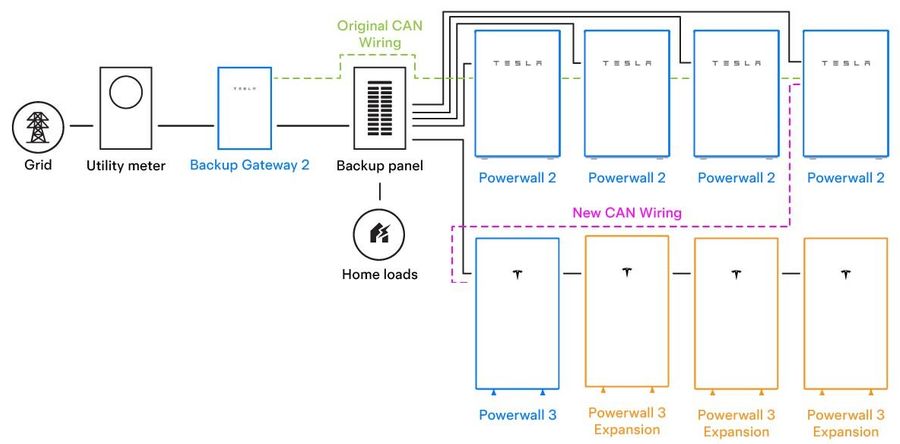
In the new mixed-generation configuration, the Powerwall 3 will communicate with the existing Powerwall 2 system through dedicated communication wiring.
During system setup:
- Powerwall 3 becomes the Site Controller.
- Backup Gateway 2 remains the islanding controller and site meter.
- The Powerwall 3 On/Off switch controls the entire battery system.
- Each Powerwall 2 switch controls only that individual Powerwall 2.
Because the Powerwall 3 becomes the primary Site Controller, this is more involved than simply installing another battery and connecting its AC wiring. The existing gateway, metering, communication wiring, electrical capacity and utility requirements must all be evaluated.
Software Requirements
The mixed Powerwall 2 and Powerwall 3 configuration requires:
- Powerwall software: Version 26.26 or later — Estimated availability: Mid-August 2026
- Tesla One: Version 25.46 or later — Available now
The installation cannot be commissioned in this configuration until the compatible Powerwall firmware is available.
Homeowners should also understand that firmware availability does not automatically mean every Powerwall 2 property will qualify. The physical equipment, electrical design, utility interconnection and applicable code requirements must still be reviewed.
Systems That Are Not Compatible
The initial release will not support every existing Tesla battery installation.
More Than Four Powerwall 2 Units
Sites containing more than four Powerwall 2 units will not be compatible with the announced mixed-generation configuration. These properties may require a different system design or complete replacement of the existing batteries.
Powerwall+ Systems
Powerwall+ cannot be combined with Powerwall 3 under this configuration. For a property with Powerwall+ equipment, all Powerwall+ units must be replaced with Powerwall 3 units.
Backup Gateway 1
Powerwall 3 is not compatible with Backup Gateway 1. A qualifying Powerwall 2 site using Backup Gateway 1 would require:
- Replacement of Backup Gateway 1 with Backup Gateway 2, where available
- Replacement of the existing Neurio meter with a Tesla Remote Meter
This additional work can significantly affect the scope and cost of the upgrade.
Existing Neurio Meter
Powerwall 3 does not support the older Neurio remote energy meter. For an existing Powerwall 2 system using Backup Gateway 2 with a Neurio meter, the Neurio meter must be replaced with a Tesla Remote Meter.
Accurate energy metering is essential because the Powerwall system uses those measurements to understand solar production, household consumption, grid import and grid export.
Important PCS Limitation
The most significant restriction involves properties required to comply with Power Control System standards.
At launch, Powerwall 3 should not be added to a Powerwall 2 system that depends on PCS functionality. Tesla expects broader support later in 2026 after UL 3141 compliance for the combined configuration has been confirmed.
A Power Control System can dynamically manage how much power a property imports from or exports to the grid. PCS functionality may also be used to keep electrical equipment within an approved current or power limit.
This means that a system may rely on PCS even when the individual Powerwall breakers appear to limit the batteries appropriately. Breaker size alone does not determine whether PCS is being used.
For a property that must remain PCS-compliant, Tesla's current direction is to replace all Powerwall 2 units with Powerwall 3 units rather than combine the two generations.
Powerwall 3 installations must also be designed around applicable electrical-interconnection requirements, including NEC 705 considerations. Tesla lists a maximum continuous AC output current of 48 amps for Powerwall 3 when evaluating these requirements.
Why PCS May Be a Challenge in San Diego
The PCS restriction may be particularly important for homeowners throughout the City and County of San Diego.
Many local battery installations use PCS-related features to address conditions such as:
- Main electrical panel limitations
- Service-conductor limitations
- Busbar capacity
- Utility import or export restrictions
- Multiple battery units connected to an existing electrical service
- Systems designed around controlled battery output
Because every property is different, eligibility cannot be determined only by looking at the number of Powerwalls installed. The original plans, equipment configuration, breaker sizes, service rating, gateway, metering equipment and commissioning settings may all need to be reviewed.
An existing Powerwall 2 owner should not assume that the compatibility update will automatically allow a Powerwall 3 to be added.
Can You Add a Powerwall 3 to Your Existing Powerwall 2 System?
A Powerwall 3 addition may be possible when the existing system has:
- Four or fewer Powerwall 2 units
- Backup Gateway 2
- Compatible Tesla metering equipment
- No Powerwall+ units
- No required PCS functionality that prevents the mixed configuration
- Adequate electrical capacity
- A system design accepted by the applicable permitting authority and utility
A property using Backup Gateway 1 or a Neurio meter may still qualify, but additional equipment replacement will be required.
A complete compatibility evaluation should be performed before equipment is ordered or an installation date is scheduled.
What Existing Powerwall 2 Owners Should Do Next
If you are considering adding storage, start by gathering the following information:
- Number of existing Powerwall 2 units
- Gateway model
- Original system plans
- Main service-panel rating
- Battery and gateway breaker sizes
- Solar inverter information
- Tesla app system information
- Permit and utility interconnection documents, when available
An onsite inspection may still be necessary to verify equipment, conductor sizes, metering and the actual installation configuration.
SHS Power's Final Take
This is a major step forward for existing Powerwall 2 owners.
Powerwall 2 availability has become increasingly limited, making it difficult to expand an existing system or replace a failed unit with matching equipment. Backward compatibility with Powerwall 3 could provide many homeowners with a practical path to add storage while retaining their existing batteries.
However, the PCS limitation will likely be one of the biggest challenges in San Diego. Many battery installations throughout the City and County of San Diego rely on power-control features because of electrical-service, panel, busbar or interconnection limitations.
SHS Power is reviewing the newly released technical information and will be investigating whether alternative designs or additional listed equipment can be used to satisfy applicable standards without requiring every Powerwall 2 to be replaced.
Any proposed solution will still need to comply with Tesla requirements, applicable electrical codes, local permitting requirements and utility interconnection standards. We will update this article as Tesla releases additional information and UL 3141 support for mixed Powerwall systems is confirmed.
Need Help Expanding an Existing Tesla Powerwall System?
SHS Power is a Tesla Certified Installer serving San Diego County.
We can inspect your existing Powerwall 2 installation, identify the gateway and metering equipment, review potential PCS limitations and determine whether your property may qualify for a Powerwall 3 addition once the required software is released.
Contact SHS Power to schedule a Powerwall compatibility assessment.
SHS Power
San Diego Solar and Battery Specialists
Tesla Certified Installer
Veteran Owned and Operated
Phone: (619) 500-8255
Get More SHS Power Updates
New solar, battery, and backup-power articles delivered occasionally.