SDCP Battery Rebate for NEM 2.0 Customers: Is It Worth It?

Jake Best
If you're an SDG&E customer with a battery system operating under NEM 2.0, you've probably seen the San Diego Community Power (SDCP) Battery Savings Program advertised as a way to earn an upfront incentive and additional payments by allowing your battery to support the electric grid.
A common question we hear at SHS Power is:
If SDCP uses up to 50% of my battery every day, won't my electric bill go up?
It's a fair question, but for most NEM 2.0 customers, the answer is probably not.
In fact, many homeowners may actually come out ahead because of how NEM 2.0 values electricity exported during peak utility hours.
How the SDCP Battery Savings Program Works
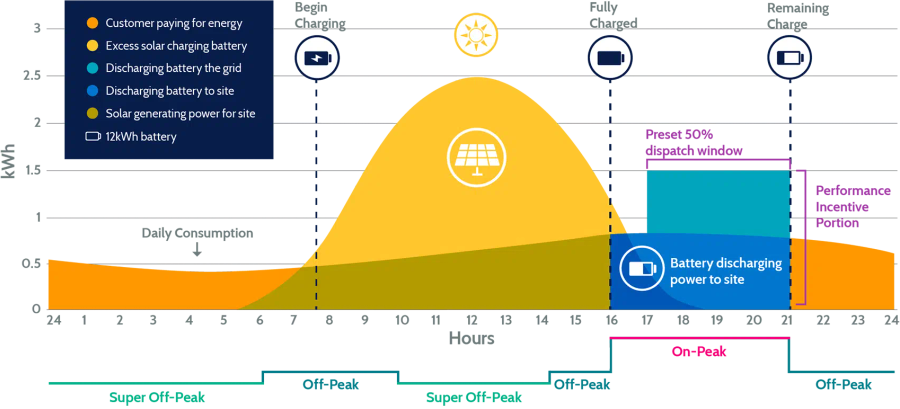
The SDCP Battery Savings Program allows participating battery systems to discharge a portion of their stored energy during periods when the electrical grid needs additional support.
Currently, the program dispatches up to 50% of your battery's usable capacity during weekday evening hours, generally between 4:00 PM and 9:00 PM.
When a dispatch occurs:
- Your battery powers your home first.
- If your home isn't using all of the available battery power, the remaining energy is exported to the electrical grid.
- You receive an upfront enrollment incentive.
In addition, SDCP pays an export performance incentive of $0.10 per kWh for qualifying energy discharged during dispatch events. This performance payment is typically issued as an annual check rather than appearing as a monthly utility bill credit.
Many homeowners immediately assume they're giving away half of their battery every day. Fortunately, that's not how the economics work under NEM 2.0.
Understanding the Five-Year Commitment
The SDCP Battery Savings Program is designed as a five-year participation agreement.
Because the upfront incentive is paid at the beginning of the program, participants are expected to remain enrolled for the full five-year term.
If you decide to leave the program early, or become ineligible before the agreement ends, a portion of the upfront incentive may need to be repaid.
The good news is that this repayment obligation is prorated. Each year you remain in the program reduces the amount that would need to be repaid, until the commitment is fully satisfied at the end of the five-year term.
For most homeowners, this simply means you should view the decision as a long-term commitment rather than something you'll likely change after a few months.
The Biggest Advantage NEM 2.0 Customers Still Have
The reason this program can work well for NEM 2.0 customers is simple:
NEM 2.0 still pays retail Time-of-Use credits for electricity exported to the grid.
That means electricity exported during SDG&E's expensive evening peak hours is credited at approximately the same retail rate you would have paid to purchase that electricity.
This creates an opportunity that many homeowners overlook.
The 5-to-1 Advantage
Let's look at a simplified example.
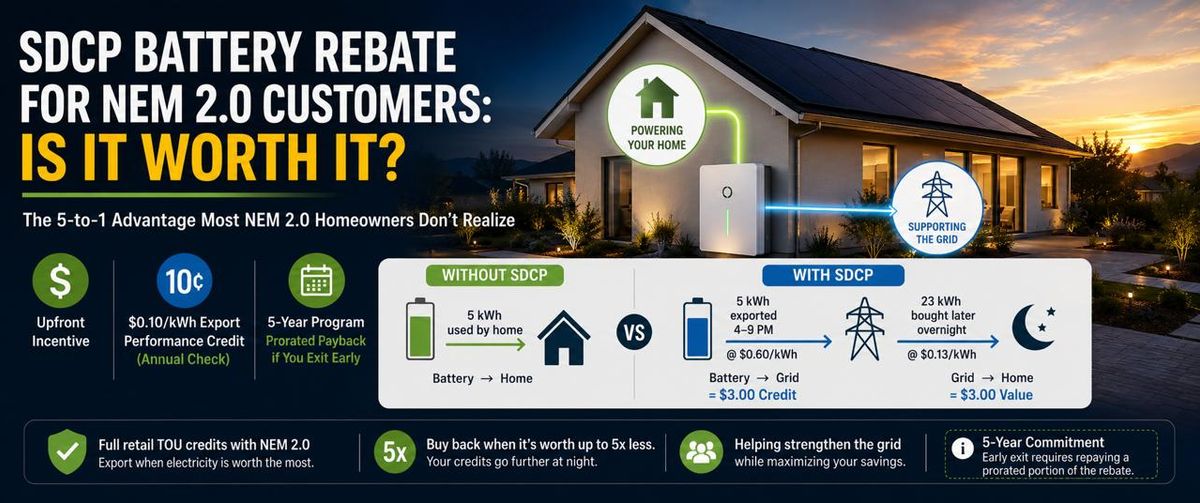
Suppose your battery exports 5 kWh between 4:00 PM and 9:00 PM, when electricity is worth approximately $0.60 per kWh.
That export creates approximately:
- $3.00 in NEM 2.0 retail bill credits.
- An additional $0.50 through the SDCP export performance incentive (5 kWh × $0.10).
Later that night, electricity may cost only $0.13 per kWh.
The $3.00 in retail credits alone can purchase approximately 23 kWh of overnight electricity.
The SDCP performance payment is an additional benefit on top of those utility bill credits.
In other words:
- You exported 5 kWh.
- You received valuable retail export credits.
- You earned an additional export performance payment from SDCP.
- You can often buy several times more electricity overnight than you exported during the expensive peak period.
You're not simply trading electricity one-for-one.
You're exporting electricity when it's at its highest value and purchasing electricity back when it's at one of the lowest prices of the day.
Is It Likely Your Electric Bill Will Increase?
For most NEM 2.0 customers, it's highly unlikely.
Because exports occur during high-value Time-of-Use periods, the credits received are often worth several times more than the electricity purchased later overnight.
On top of those utility bill credits, participants also receive the $0.10 per kWh export performance payment, making the overall economics even more attractive.
That means many homeowners can receive:
- An upfront enrollment incentive.
- Annual export performance payments.
- Full retail NEM 2.0 export credits.
- Access to inexpensive overnight electricity when needed.
In many situations, those combined benefits outweigh the value of simply keeping additional energy stored in the battery overnight.
There Are Some Exceptions
Like most things involving utility rates, every home is different.
The program deserves a closer evaluation if:
- You regularly drain your battery before sunrise.
- You have unusually high overnight electrical usage.
- You own only one battery serving a large home.
- Your primary goal is maximizing backup power rather than reducing your electric bill.
- You think there's a reasonable chance you'll move or want to leave the program before the five-year commitment ends.
Fortunately, these situations are the exception rather than the rule for most NEM 2.0 customers.
NEM 2.0 and NEM 3.0 Are Very Different
One of the biggest misconceptions surrounding the SDCP Battery Savings Program is assuming it works the same for every homeowner.
It doesn't.
This article applies specifically to NEM 2.0 customers.
Customers on California's newer Solar Billing Plan (NEM 3.0) are compensated differently for exported electricity. Instead of receiving retail Time-of-Use credits, exports are generally paid based on California's Avoided Cost Calculator, where export values are often only a few cents per kilowatt-hour except during certain high-value periods.
Because of that, the economics for NEM 3.0 customers are completely different and deserve their own analysis.
SHS Power's Perspective
At SHS Power, we believe homeowners should understand exactly how a program affects their utility bill before enrolling.
For many NEM 2.0 customers, the SDCP Battery Savings Program offers multiple layers of value:
- An upfront enrollment incentive.
- Annual export performance payments.
- Full retail Time-of-Use export credits under NEM 2.0.
- The ability to export electricity when it is most valuable and purchase electricity later when rates are significantly lower.
Just as importantly, homeowners should understand that enrolling is a five-year commitment, and leaving the program early may require repaying a prorated portion of the upfront incentive.
At SHS Power, we review your utility data, battery size, and energy usage to determine whether the program is likely to benefit your specific home before making a recommendation.
Get More SHS Power Updates
New solar, battery, and backup-power articles delivered occasionally.