What Is a Power Control System for Solar and Battery Storage?
A Power Control System (PCS) uses certified controls and real-time monitoring to keep your solar and battery installation within safe, permitted electrical limits. Learn how PCS works and why it matters for San Diego homeowners.
Modern solar and battery systems can produce a significant amount of electrical power. In many homes, the combined output of the solar panels, battery inverters and utility service can exceed what the existing electrical panel, busbar or service conductors were originally designed to handle.
A Power Control System, commonly called a PCS, uses certified controls and real-time energy monitoring to keep the electrical system within safe, permitted operating limits.
Instead of relying only on fixed breaker sizes, a PCS can continuously monitor the flow of electricity and automatically adjust the output of a solar or battery system when necessary.
This technology can make it possible to install solar panels, home batteries or multiple energy systems without replacing every part of the home's existing electrical infrastructure.
However, PCS requirements can also affect which batteries can be installed, how equipment can be combined and whether an existing solar or battery system can be expanded.
What Does PCS Mean?
PCS stands for Power Control System.
A PCS is a listed combination of hardware, software, current transformers, meters and control equipment that manages electrical power within defined limits.
Depending on the system design, a PCS may control:
- Battery charging and discharging
- Solar inverter production
- Power imported from the utility
- Power exported to the utility
- Power flowing through a main service panel
- Power flowing through a subpanel
- Power flowing through specific conductors
- The combined output of multiple solar and battery inverters
Tesla describes PCS as a software-controlled system designed to meet requirements established under UL 1741 and NEC Article 705.13. The system combines active controls with traditional breakers and overcurrent protection to provide safe operation.
Why Is a Power Control System Needed?
Electrical panels and service equipment have maximum current ratings.
For example, a home may have a 200-amp electrical service, but that does not mean an unlimited amount of solar and battery equipment can be connected to the panel. The panel busbar, main breaker, feeder conductors and equipment connections all have ratings that must be considered.
A traditional system design typically controls power using:
- Main breaker size
- Solar and battery breaker sizes
- Panel busbar ratings
- Conductor sizes
- Equipment ratings
- Physical points of connection
These methods work well, but they can limit how much generation or battery capacity can be added.
A PCS introduces active power management. The system measures electrical flow and reduces inverter or battery output before a protected component exceeds its approved limit.
In simple terms, the PCS acts like an intelligent traffic controller for electricity.
It does not increase the physical capacity of a panel or conductor. Instead, it ensures that the solar and battery equipment operates within the capacity that is already available.
How Does a PCS Work?
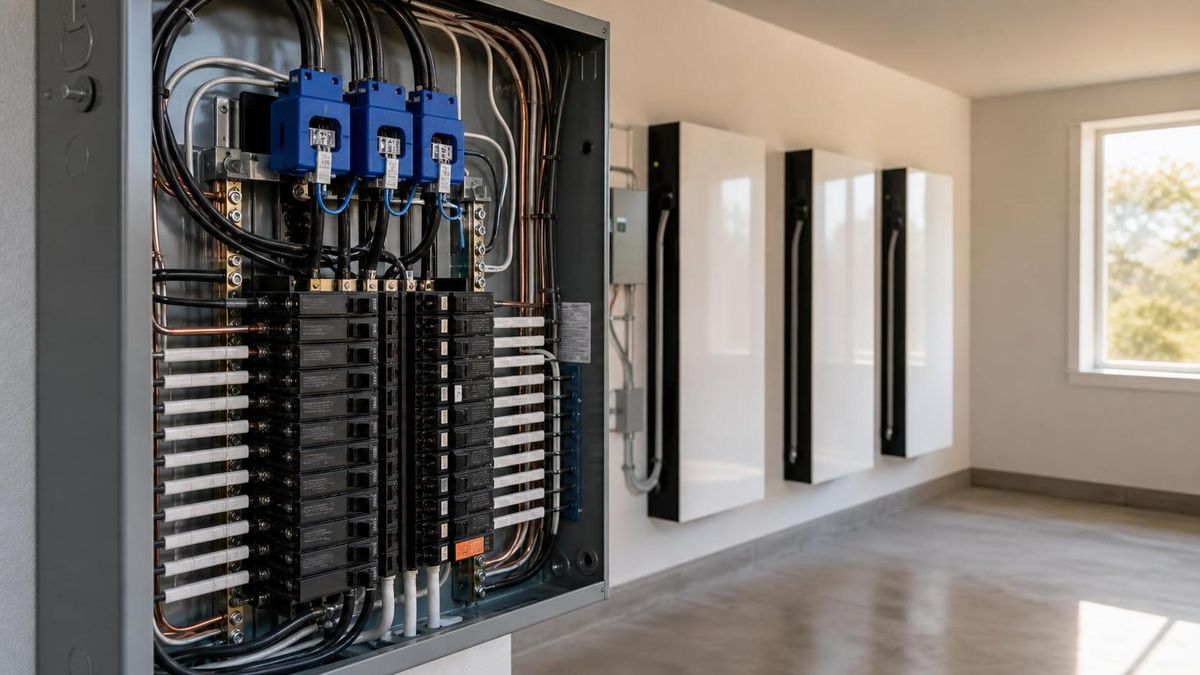
A typical PCS uses current transformers, often called CTs, or approved energy meters to measure power at specific locations.
These measurements may include:
- Utility-grid import
- Utility-grid export
- Household electrical consumption
- Solar production
- Battery output
- Power entering a panel
- Power passing through a protected conductor
The system controller constantly evaluates those measurements.
If electrical flow approaches a configured limit, the controller can reduce the output of the battery or solar inverter. When electrical demand drops and capacity becomes available again, the system can increase its output.
This process occurs automatically and does not normally require action from the homeowner.
A Simplified Example
Consider a home where the electrical design permits a maximum of 100 amps through a particular panel or set of conductors.
The house is currently consuming 70 amps.
Without power controls, adding another 40 amps of battery output could create a potential 110-amp condition.
A properly designed PCS would recognize that only 30 amps of additional capacity is currently available. It would temporarily limit the battery to prevent the protected equipment from exceeding the established 100-amp limit.
When the household load decreases, more battery output may become available.
The exact behavior depends on the equipment, system configuration, permitted plans and PCS feature being used.
Common Types of Power Control
PCS is not limited to one feature. Different controls may be used to solve different electrical-design problems.
Panel Limit
A panel limit protects an electrical panel from receiving more current than its approved rating.
This may be useful when several sources of power including the utility, solar and batteries are connected to the same panel.
The PCS monitors power flow and adjusts inverter output to prevent the panel from exceeding the configured limit.
Conductor Limit
A conductor limit protects a set of electrical wires or feeders.
This may be used when the conductors supplying a panel are smaller than the maximum potential output of the connected utility, solar and battery equipment.
The PCS limits controllable equipment before current through those conductors exceeds the permitted value.
Site Limit
A site limit controls the total amount of power imported from or exported to the utility.
For example, a property may be limited to a specific level of grid import because of the electrical-service rating. The PCS can reduce battery charging when the home approaches that import limit.
A site limit may also be used to restrict the amount of energy exported to the grid.
Power or Current Limit
Some battery inverters can be configured with a maximum power or current output.
Tesla's technical documentation allows Powerwall 3 output to be limited below its normal breaker configuration when an approved power or current limit is properly designed and commissioned. Tesla notes that Powerwall 3 normally uses an independent 60-amp circuit breaker, although a smaller breaker may be used with the appropriate configured limitation.
Permanent Non-Export
Permanent non-export prevents a new solar or battery system from increasing the amount of energy sent to the utility grid.
The system continuously measures electrical flow and adjusts production or charging to keep the property within its permitted export conditions.
Tesla states that certain Powerwall configurations operating in Permanent Non-Export mode can comply with the applicable UL 3141 non-export requirements.
What Is UL 3141?
UL 3141 is a safety standard addressing Power Control Systems used with distributed energy resources such as solar and battery storage.
It provides a framework for evaluating whether a PCS can reliably maintain required limits under normal operation and foreseeable system conditions.
Depending on the installation, UL 3141-related functions may be used to control:
- Utility export
- Utility import
- Panel loading
- Conductor loading
- Inverter output
- The interaction of multiple energy systems
A manufacturer stating that an inverter has power-limiting capabilities does not automatically mean every possible system combination is PCS-compliant.
The complete configuration may need to be evaluated, including:
- Inverters
- Batteries
- Controllers
- Firmware
- Metering equipment
- Communication wiring
- System topology
- Configured limits
- Failure-response behavior
- Equipment listed together for the intended application
This distinction becomes especially important when mixing different battery generations, inverter models or manufacturers.
The California Energy Commission (CEC) maintains a publicly searchable database of certified solar and energy storage equipment, including PCS devices, batteries and PV modules. Homeowners and installers can use this database to verify whether specific equipment has been evaluated and listed for use in California: CEC Approved Solar Equipment List
PCS Is More Than a Breaker Setting
One common misunderstanding is that installing a smaller breaker automatically creates a compliant PCS design.
A breaker provides overcurrent protection, but it does not actively manage energy flow.
A PCS performs a different function. It monitors the system and controls inverter output before the protected electrical equipment exceeds the approved operating limit.
A smaller breaker may be part of a PCS design, but the breaker alone does not replace:
- Certified power controls
- Approved system programming
- Required energy metering
- Current transformers
- Communication wiring
- Plan-set documentation
- Equipment labeling
- Proper commissioning
Tesla's PCS documentation separately identifies required breakers, equipment configuration, plan labeling, panel labeling and CT labeling.
Why PCS Is Important for San Diego Homes
PCS is especially relevant in San Diego because many local homes were built before large residential solar and battery systems were common.
A home may now have several major electrical loads and energy sources that were not considered when the original service was installed, including:
- Solar panels
- One or more home batteries
- Electric vehicle chargers
- Heat-pump HVAC systems
- Electric water heaters
- Pool or spa equipment
- Accessory dwelling units
- Electric cooking appliances
- Additional subpanels
- Existing solar combined with a new battery system
Even homes with 200-amp electrical service can encounter panel, busbar or conductor limitations when multiple energy systems are added.
The City of San Diego requires an electrical permit for residential photovoltaic and energy-storage installations. The permitted system must therefore be supported by an acceptable electrical design rather than simply by the equipment manufacturer's advertised output rating.
PCS Can Sometimes Avoid a Main Panel Upgrade
Without PCS, adding a large battery system may require modifications such as:
- Replacing the main service panel
- Increasing the service rating
- Replacing feeder conductors
- Adding a new distribution panel
- Reducing the battery-system size
- Reducing the number of battery units
- Moving the point of connection
- Creating a separate backed-up loads panel
A properly approved PCS design may allow the new system to operate safely without some of these upgrades.
This can potentially reduce:
- Installation cost
- Utility coordination
- Trenching
- Stucco or drywall repairs
- Permit complexity
- Project duration
- The need to relocate existing electrical equipment
PCS does not eliminate the need for a panel upgrade in every situation. If the service equipment is damaged, obsolete, physically full or inadequate for the home's actual loads, replacement may still be the correct solution.
PCS Can Allow Larger Battery Systems
A battery system can place power onto the home's electrical system while solar and utility power are also available.
When multiple batteries are installed, their combined potential output can become substantial.
PCS may allow a larger amount of battery storage to be installed while limiting the maximum instantaneous output to a safe value.
This distinction is important:
Battery capacity describes how much energy the batteries can store, generally measured in kilowatt-hours.
Battery power describes how quickly that stored energy can be delivered, generally measured in kilowatts.
A homeowner may be able to install additional storage capacity while using PCS to control the maximum power delivered through a specific panel or conductor.
This can provide longer backup duration without requiring the electrical system to support the unrestricted maximum output of every battery simultaneously.
PCS and Existing Solar Systems
PCS is frequently used when adding batteries to an existing solar installation.
The original solar system may already use a significant portion of the panel's available interconnection capacity. Adding a battery inverter creates another possible source of electrical power.
An approved PCS may coordinate the existing solar and new battery system by:
- Limiting combined output
- Preventing additional grid export
- Controlling battery charging
- Protecting a panel or conductor
- Monitoring the existing solar separately
- Maintaining an approved utility operating mode
However, compatibility depends on how the existing solar is connected and whether the new equipment is listed or approved for the proposed control method.
PCS and Non-Export Battery Systems
Non-export designs have become increasingly important for homeowners who want to add new solar or battery equipment without changing the export authorization of an existing solar system.
For example, a home may have an older solar system under a favorable utility agreement. The homeowner may want to add more solar or battery storage but prevent the new equipment from sending additional energy to the grid.
An approved non-export control can measure power at the utility connection and reduce the new system's output when export would otherwise occur.
This may allow the existing system to continue operating under its authorized configuration while the new system serves household loads or charges batteries.
The exact utility, equipment and permitting rules must be reviewed for each project. Non-export should never be treated as a software setting that can be enabled without proper design and approval.
PCS and Tesla Powerwall Systems
Tesla Powerwall systems can use several PCS features, depending on the equipment and system design.
These may include:
- Panel Limit
- Conductor Limit
- Site Limit
- Power or Current Limit
- Permanent Non-Export
- Import limiting
- Export limiting
The Powerwall controller uses approved metering and communications to manage these limits.
Because the PCS functionality depends on the complete Tesla system configuration, changing a major component can affect compliance.
Examples include:
- Replacing a Powerwall 2 with a Powerwall 3
- Adding Powerwall 3 to an existing Powerwall 2 installation
- Replacing a Backup Gateway
- Changing the remote energy meter
- Adding another battery
- Adding more solar
- Relocating system CTs
- Changing the backed-up loads
- Reconfiguring the electrical point of connection
This is why an equipment combination can be electrically functional but still not approved as a PCS configuration.
How Do You Know Whether Your Home Uses PCS?
Most homeowners will not see PCS prominently displayed in the Tesla app or on the front of their electrical equipment.
PCS use is usually identified through the permitted system design and commissioning configuration.
Possible indicators include:
- PCS notes on the approved plans
- Panel Limit or Site Limit shown in Tesla One
- Export or import limits in the commissioning records
- CTs installed around panel or service conductors
- Labels identifying PCS-controlled equipment
- A battery breaker smaller than the equipment's standard configuration
- Multiple batteries connected to a limited panel
- Permanent non-export operation
- A prior installer stating that the battery was power-limited
- A system designed to avoid a main-panel upgrade
None of these indicators independently confirms the exact PCS configuration. The complete system should be reviewed by a qualified installer.
What Equipment Is Usually Involved?
A PCS-controlled solar or battery installation may include:
- Solar inverter
- Battery inverter
- System controller
- Backup gateway
- Remote energy meter
- Current transformers
- Main electrical panel
- Backup-load panel
- Generation panel
- Breakers and disconnects
- Communication wiring
- Internet connectivity
- Approved firmware
The location and direction of the CTs are especially important. Incorrect CT placement can cause the controller to misunderstand the direction or amount of power flowing through the home.
A commissioning error could result in inaccurate monitoring, improper battery operation or failure to maintain the intended limit.
Does PCS Affect Backup Power?
It can.
Some PCS limits apply during normal grid-connected operation, while other equipment ratings remain relevant during an outage.
When the utility grid is present, the controller may limit battery output to protect the service equipment or maintain an import or export limit.
During an outage, the gateway isolates the home from the utility. The system then operates as a local microgrid, and the available backup output depends on:
- Number and model of batteries
- Battery state of charge
- Inverter capacity
- Backed-up panel configuration
- Solar availability
- Starting requirements of large appliances
- System controls
- Equipment ratings
A qualified system design should consider both grid-connected PCS operation and off-grid backup performance.
Can PCS Fail?
PCS standards require manufacturers to consider communication failures, meter failures, controller faults and other abnormal conditions.
Depending on the system and feature, a loss of metering or communication may cause the controlled inverter to:
- Reduce output
- Stop exporting
- Stop charging
- Disconnect
- Enter a restricted operating state
- Display a fault requiring service
This fail-safe behavior is one reason that listed equipment, approved firmware and proper commissioning are essential.
A field-created control using unsupported relays, third-party meters or undocumented software settings may not provide the tested failure response required for a compliant PCS.
Can Any Electrician Modify a PCS System?
PCS-controlled installations require a strong understanding of:
- Solar and battery system design
- NEC interconnection requirements
- Manufacturer specifications
- Utility requirements
- CT installation
- Communication wiring
- Inverter programming
- Permit documentation
- System commissioning
An electrician may be highly qualified for traditional residential wiring but unfamiliar with the software and metering requirements of a particular battery platform.
Whenever a PCS-controlled system is modified, the installer should understand both the electrical installation and the manufacturer's commissioning platform.
When Should a PCS System Be Re-Evaluated?
A PCS design should be reviewed whenever the homeowner plans to:
- Add another battery
- Replace a battery with a different model
- Add more solar panels
- Replace a solar inverter
- Add an EV charger
- Add an ADU
- Upgrade the main panel
- Add a new subpanel
- Move backed-up loads
- Relocate CTs
- Replace a gateway
- Change the utility export arrangement
- Combine equipment from different manufacturers
Changes to the home's electrical system can affect the limits and assumptions used in the original design.
PCS Does Not Replace Proper Electrical Design
A PCS is a useful tool, but it should not be used to cover up an unsafe or poorly designed electrical system.
Before using PCS, the installer should verify:
- Panel condition
- Busbar rating
- Main breaker rating
- Conductor sizes
- Connection locations
- Available breaker space
- Grounding and bonding
- Existing solar configuration
- Utility service capacity
- Manufacturer compatibility
- Required permit details
In some cases, replacing or reorganizing the electrical equipment is more reliable than building a complicated control strategy around outdated infrastructure.
The goal should be the safest and most practical long-term design, not simply avoiding a panel upgrade at any cost.
SHS Power's Approach to PCS Design
SHS Power evaluates the complete electrical system before recommending a solar or battery expansion.
Our review may include:
- Main service-panel rating and condition
- Busbar and breaker configuration
- Existing solar-system output
- Battery inverter output
- Service and feeder conductor sizes
- Existing CT and meter locations
- Gateway and controller models
- Utility import and export requirements
- Backup-load requirements
- Manufacturer PCS compatibility
- Approved plans and commissioning records
We use this information to determine whether the project should use:
- A listed PCS configuration
- A panel or conductor limit
- A power-limited battery design
- Permanent non-export
- A new backup-load panel
- A supply-side connection
- A main service-panel upgrade
- Another approved interconnection method
Not every solution is appropriate for every home.
Have an Existing Solar or Battery System?
Adding a battery or expanding an existing system requires more than confirming that there is physical space on the wall.
The electrical service, equipment ratings, existing solar, utility authorization and PCS configuration must all work together.
SHS Power can inspect your existing system, review the available plans and determine which expansion options are technically and legally available.
Contact SHS Power for a system evaluation.
SHS Power
San Diego Solar and Battery Specialists
Tesla Certified Installer
Veteran Owned and Operated
Phone: (619) 500-8255